Abnormal Returns & Correlation

Understanding whether share price movements reflect company news or broader market conditions.

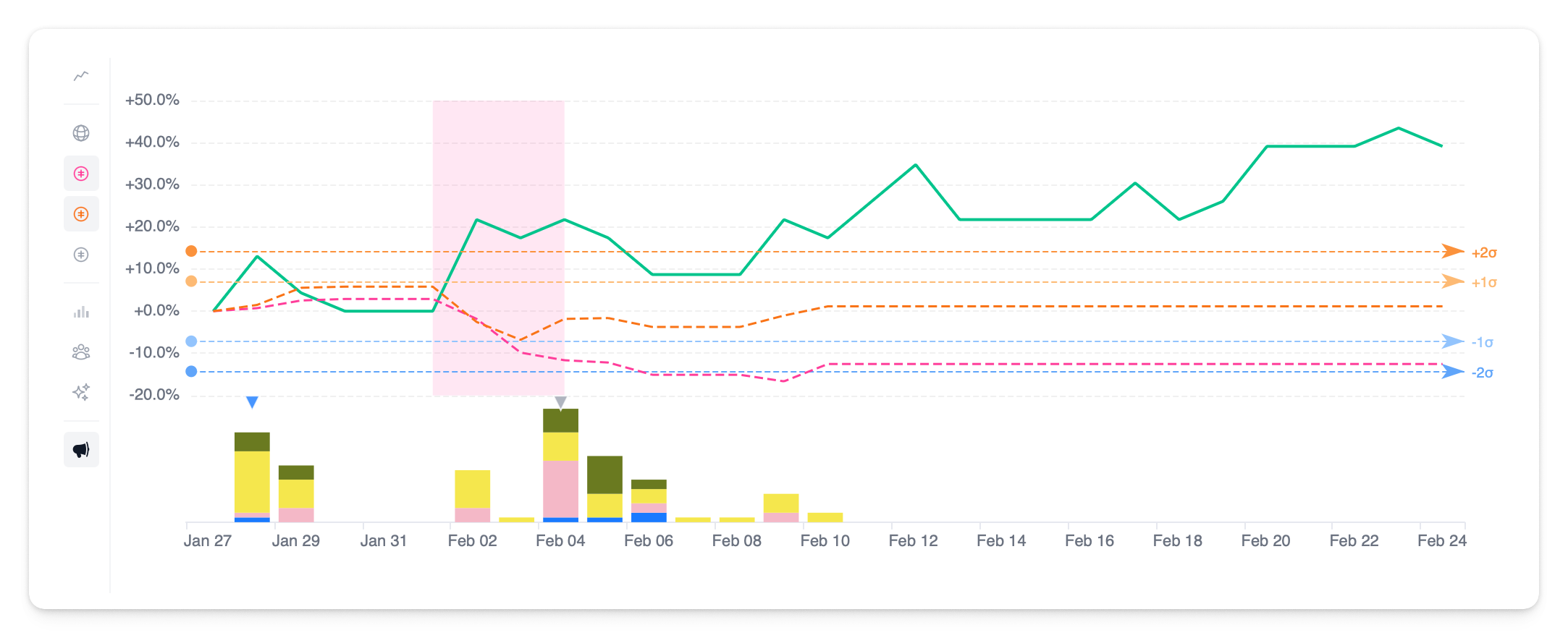
Stock vs Benchmark chart showing company performance against index


Abnormal Returns (AR)

Abnormal return is the difference between your stock's actual return and its expected return, calculated using the Capital Asset Pricing Model (CAPM) with a rolling estimation window. It eliminates the impact of wider market movements, letting you see whether today's performance is genuinely unusual.

Your stock's actual return minus the return you'd expect given how the benchmark moved that day. If the ASX 200 drops 3% and your stock drops 3%, that's expected — the abnormal return is ~0%. But if the ASX drops 3% and your stock drops 8%, the abnormal return is about -5%.


How AR Is Calculated

The expected return is calculated using CAPM, which factors in your stock's historical relationship with the market over a rolling estimation window.

Expected Return=α+β×RmarketAbnormal Return=RactualExpected Return\begin{aligned} \text{Expected Return} &= \alpha + \beta \times R_{market} \\ \text{Abnormal Return} &= R_{actual} - \text{Expected Return} \end{aligned}
SymbolMeaning
α\alpha (alpha)Stock's baseline return independent of the market
β\beta (beta)Stock's sensitivity to market movements (from linear regression)
RmarketR_{market}Benchmark return (default: ASX 200)
RactualR_{actual}Your stock's actual return on the day

Identifying Unusual Days

The platform calculates a z-score for each day's AR to identify statistically unusual performance:

Z-Score=ARARσAR\text{Z-Score} = \frac{AR - \overline{AR}}{\sigma_{AR}}
Z-ScoreFlagConfidence
> +1.96 or < -1.96Positive/Negative spike95% confidence
> +3.0 or < -3.0Extreme positive/negative spike99.7% confidence
Between ±1.96No spikeWithin normal range

Spike flags appear on day-to-day markers throughout the activities chart, making it easy to spot unusual trading days at a glance.

Activities chart showing spike flag markers on unusual trading days

To view only activities from unusual trading days, open the filters panel on the Activities page and select Unusual or Very Unusual from the Market Activity filter.


Configuring Your Benchmark

SettingsMarketBenchmark Configuration

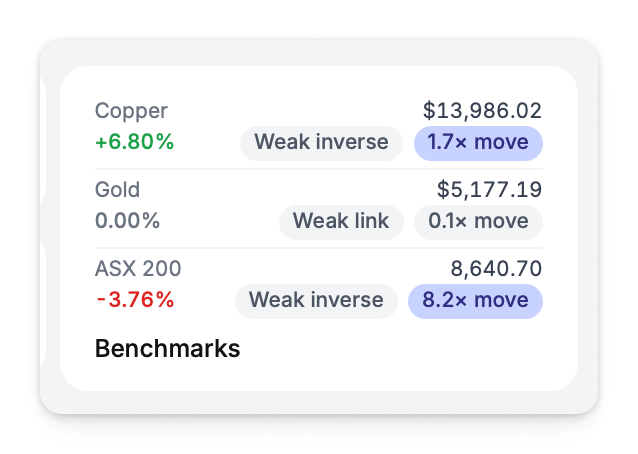
See Available Benchmarks for the full list of indices and commodities.

Market settings benchmark configuration panel
SettingBehaviour
DefaultAXJO (ASX 200)
Index onlyUses selected index (e.g., XMJ for Materials)
Commodity onlyUses selected commodity (e.g., Gold)
Both selectedCommodity takes priority
Neither selectedFalls back to general market performance
info

Each company can fully customise their benchmark. A gold miner might use Gold price. A diversified miner might use XMJ. A tech company might use AXAT.


Cumulative Abnormal Returns (CAR)

Cumulative Abnormal Return accumulates AR results across an event study window. While AR tells you about a single day, CAR tells you whether an impact was sustained or just a "sugar hit."

CAR(t1,t2)=t=t1t2ARt\text{CAR}(t_1, t_2) = \sum_{t=t_1}^{t_2} AR_t

Event Study Windows

The platform calculates CAR across multiple windows to capture different aspects of market reaction:

WindowNotationWhat It Shows
Announcement dayAR(0)Immediate same-day reaction
Pre-announcementCAR(-3,-1)3 days before announcement
Short windowCAR(-1,+1)Day before through day after
Post-announcementCAR(0,+10)Announcement through 10 days after
Extended pre-windowCAR(-5,-1)5 days before announcement

CAR event study chart from an announcement detail panel

Interpreting CAR:

  • Sustained positive CAR(0,+10) – Market views the news favourably; impact held
  • Sustained negative CAR(0,+10) – Market views news unfavourably; impact held
  • CAR returning to zero – Initial reaction was a sugar hit; market corrected
tip

Compare CAR across announcements of the same category to understand which types drive sustained impact versus temporary spikes.


Leak Detection

CAR is also used for pre-announcement leak detection. The platform checks whether the pre-announcement window is "clean" (no other announcements) and looks at CAR(-3,-1) and CAR(-5,-1).

How it works:

  1. Calculate cumulative abnormal return in the 3–5 days leading up to an announcement
  2. Check if the pre-window is clean (no other company announcements in that period)
  3. If clean and there's significant CAR in the same direction as the announcement day, flag for investigation
warning

A sharp rise before a positive announcement—or a sharp fall before negative news—in a clean pre-window may indicate information leaked before the official disclosure. This is an early warning for continuous disclosure compliance.

Example: If an announcement results in +5% AR(0), but the stock had already risen +3% CAR(-3,-1) with no other news in that window, that pattern warrants investigation.


Correlation Coefficient

Correlation measures how closely your share price moves with a benchmark—either a commodity or an index—over time.

A Pearson correlation coefficient ranging from -1 to +1 showing how closely two variables move together.


How Correlation Works

The platform calculates day-by-day returns for both your stock and the selected benchmark, then computes the Pearson correlation over a rolling window (default: 90 days).

CorrelationMeaning
+0.7 to +1.0Strong positive – moves in lockstep with benchmark
+0.4 to +0.7Moderate positive – generally follows benchmark
-0.4 to +0.4Weak/none – other factors driving price
-0.7 to -0.4Moderate negative – tends to move opposite
-1.0 to -0.7Strong negative – moves opposite to benchmark

Additional metrics calculated:

  • Beta – Market sensitivity (slope from regression)
  • R-squared – Variance explained by the benchmark

What Correlation Tells You

High correlation means your share price closely follows the benchmark. For a gold miner, high correlation with gold price is expected—the market treats you as a gold proxy.

Low correlation means other factors are influencing your price beyond the commodity or index:

  • Company-specific news
  • Management changes
  • Operational issues
  • Market sentiment about your company specifically
info

Short-term correlation can diverge significantly from long-term patterns during company-specific events.


Correlation vs. AR

MetricQuestion It Answers
ARDid today's performance differ from what the market model predicted?
CorrelationHow closely does our stock follow the benchmark over time?

Use AR for event analysis (what happened today). Use correlation for market positioning (how does the market categorise us).


Putting It Together

The platform uses these metrics in combination:

  1. AR for day-to-day monitoring – flags unusual performance immediately via z-score spikes
  2. CAR for announcement impact – shows whether reactions sustain or fade over 10 days
  3. CAR (pre-announcement) for leak detection – flags suspicious movements in clean pre-windows
  4. Correlation for market context – explains whether movements are company-specific or market-driven
tip

When your stock moves against its usual correlation with the benchmark, that's a signal to investigate. Either company-specific news is driving the price, or there's unusual activity worth understanding.